
This guide describes the Meetical admin section in Confluence: where to find it, what each tab does, and which settings apply to the whole site versus a single user. It is written for Confluence site administrators and solution partners. For installation, rollout and the browser extension, see the Installation and Power User Guide.
Overview
Where to find the admin section
Open Confluence Settings (the gear icon on the top right next to your user account icon), then under Apps choose “Meetical Admin”. Confluence also lists a Getting started entry for Meetical, which is a short first-run page that links into the admin section.
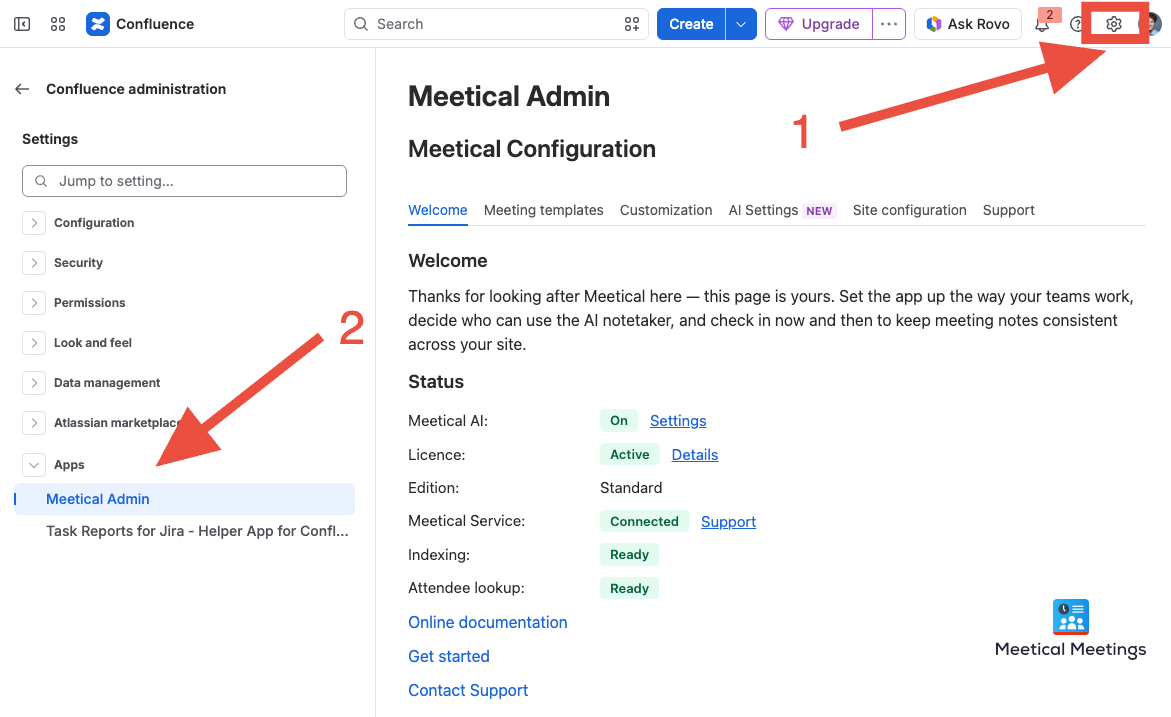
Who can change settings
Only Confluence site administrators can view this page and change a setting.
Site-wide versus per-user settings
Meetical has three levels of configuration. Understanding them avoids most support questions.
|
Level |
Set by |
Where |
Examples |
|---|---|---|---|
|
Site |
Confluence admin |
Admin section |
Meetical AI on or off, who may use the AI notetaker, default note settings, global meeting templates |
|
Space and organisation, label driven |
Anyone who can edit the page |
Labels on pages and templates |
Preferred parent pages, preferred templates, defaults per space |
|
User |
Each user |
Meetical Calendar, Create page and Agenda settings, AI notes settings |
Calendar connection, page location, per-space note preferences, per-series automation, ai-preferences |
Site defaults never override a choice a user has already made. A per-series setting wins over a user's space setting, which wins over the site default. There is currently no way to force an org-wide setting on all users. If your organization needs that, tell us via the support portal.
Welcome tab and site status
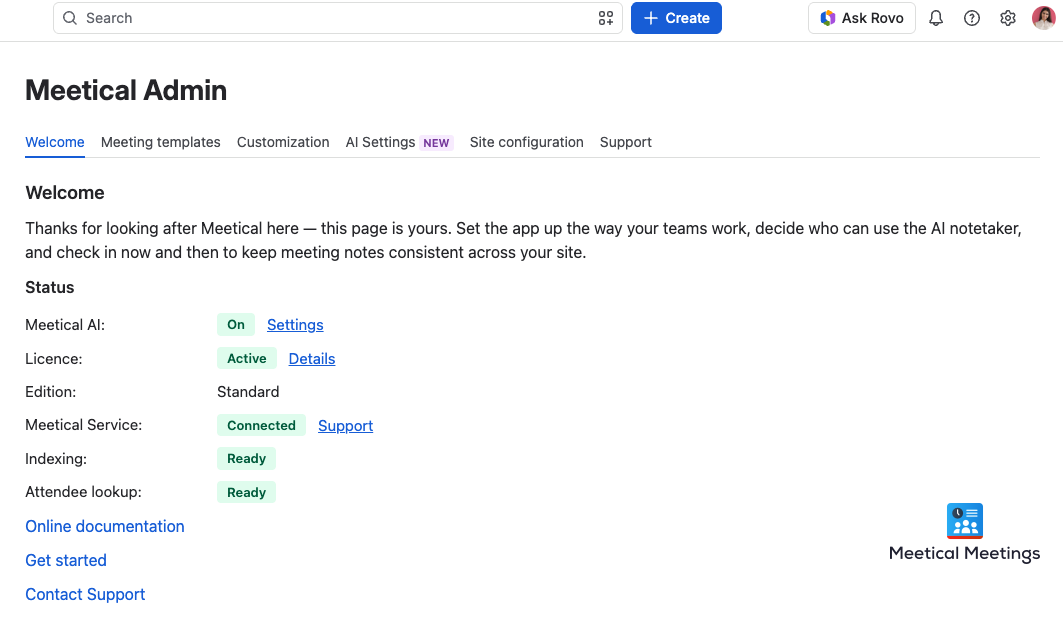
The first tab shows a status overview of your Meetical installation. Each row links to the tab where you can act on it.
|
Row |
Values |
What it means |
|---|---|---|
|
Meetical AI |
On / Off |
The site-wide AI switch, see AI settings. A warning banner appears while it is off. |
|
Licence |
Active / Inactive / Not reported |
Licence status as reported by Atlassian. "Not reported" usually means the app was installed moments ago. |
|
Edition |
Standard / Advanced |
The Marketplace edition your site is on. |
|
Meetical Service |
Connected / Not connected |
Whether the app has registered with the Meetical backend. If not connected, see Support. |
|
Indexing |
Ready / Not indexed |
Whether Confluence has indexed Meetical's page properties. Without it, meeting reports and parent page lookups return nothing. Errors here are many times related to an outage of Confluence itself. |
|
Attendee lookup |
Ready / Not ready |
Whether the email-to-user cache is populated. It is needed to map calendar attendees to Confluence users for @mentions and watchers. |
Meeting templates
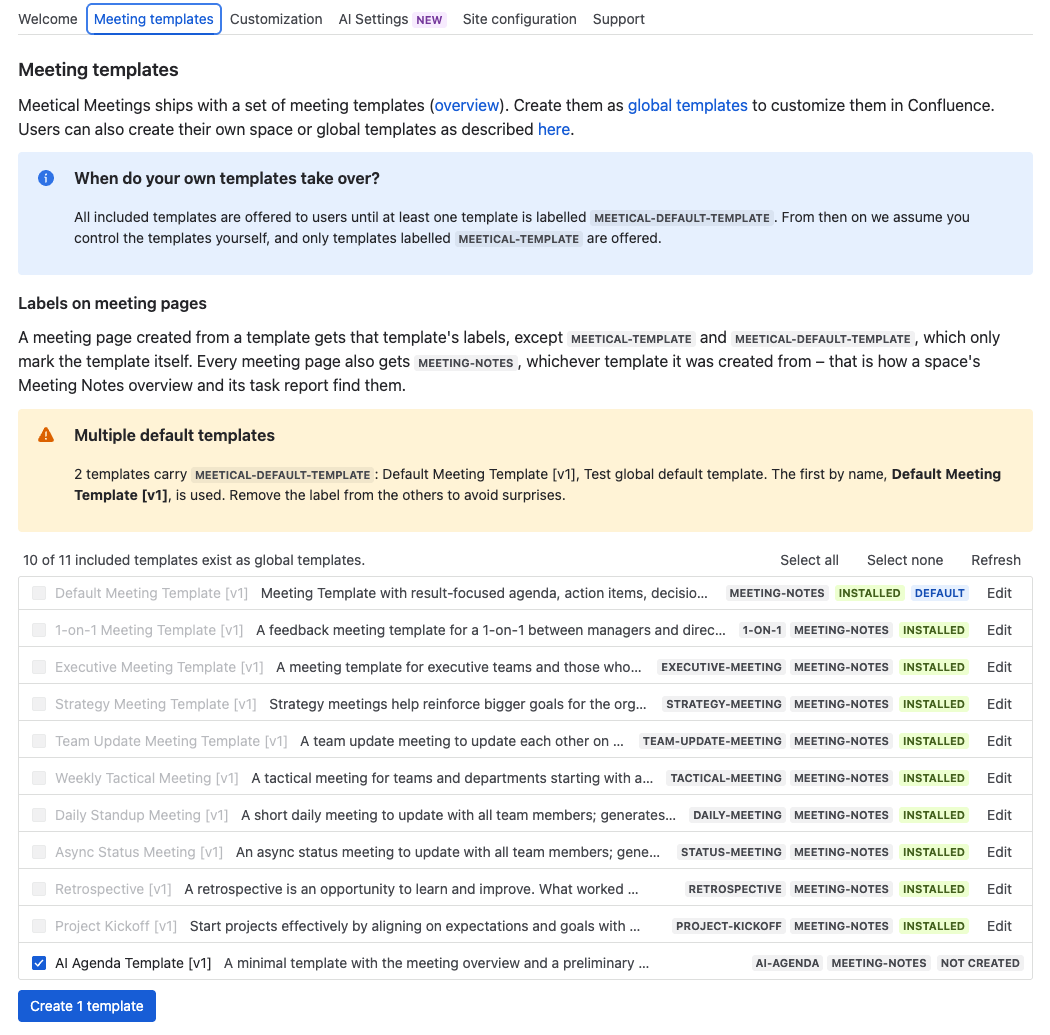
Meetical ships a set of meeting templates. This tab lists them and lets you install them as global Confluence templates in one step.
Space templates are supported too, but not listed here (yet). Check the Templates docs section.
For each template you see:
-
the name and a description preview on hover,
-
the labels it will put on meeting pages created from it,
-
a status: Installed or Not created ,
-
a default lozenge if it carries the default template label,
-
an Edit button that opens the template in the Confluence template editor.
Installing templates
-
Tick the templates you want, or use Select all.
-
Click Create N templates. They are created as global templates, so they are available in every space.
-
Use Refresh to re-read the current state after editing templates in Confluence.
Which templates are offered to users
Until at least one template carries the label meetical-default-template, users are offered all bundled templates. From the moment a default is set, only templates labelled meetical-template or meetical-default-template are offered. This lets you take over the template list completely with your own templates.
The tab warns you when:
-
No default template is set. Users see the full bundled list.
-
Multiple default templates exist. The first by name is used. Remove the label from the others.
Space templates follow the same rules and take priority over global templates, so teams can define their own default. Read the full guide on customising Meetical templates.
Customisation with labels
Meetical is configured largely through Confluence labels rather than admin toggles. This keeps the configuration in Confluence, visible to everyone, and lets space owners manage their own structure.
|
Label |
Put it on |
Effect |
|---|---|---|
|
|
A page |
Offers the page as a preferred location for new meeting notes in that space. |
|
|
A page |
Makes the page the default location for new meeting notes in that space. One per space. |
|
|
A template |
Offers the template when users create a meeting page. |
|
|
A template |
Pre-selects the template and switches the template list to labelled templates only. One per scope. |
Parent pages by space
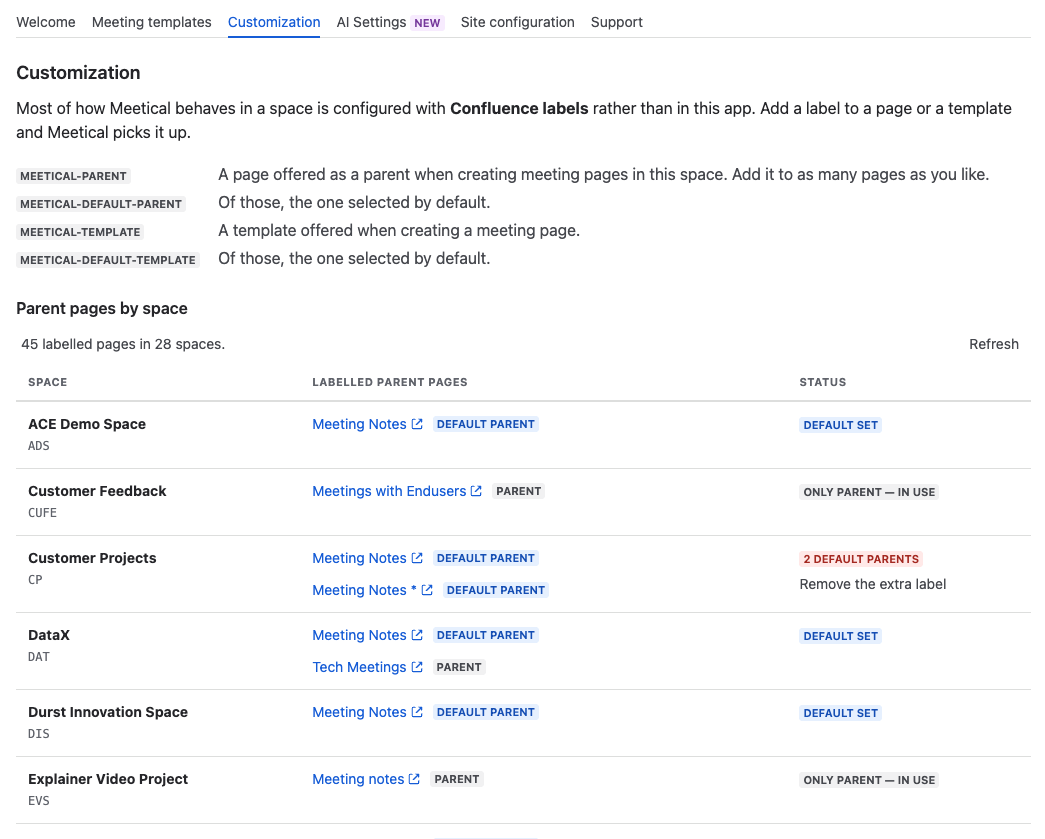
The tab lists every page on the site that carries one of the two parent labels, grouped by space, with a status per space:
-
Default set : exactly one default parent.
-
No default parent : several preferred parents but no default. The first by title is used.
-
N default parents : more than one default. Remove the extra label.
-
Only parent, in use : a single labelled page, used as the location.
Click Refresh after changing labels. Without any label, Meetical creates a "Meeting Notes" index page in the space on first use. See structuring spaces with multiple parent pages.
AI settings
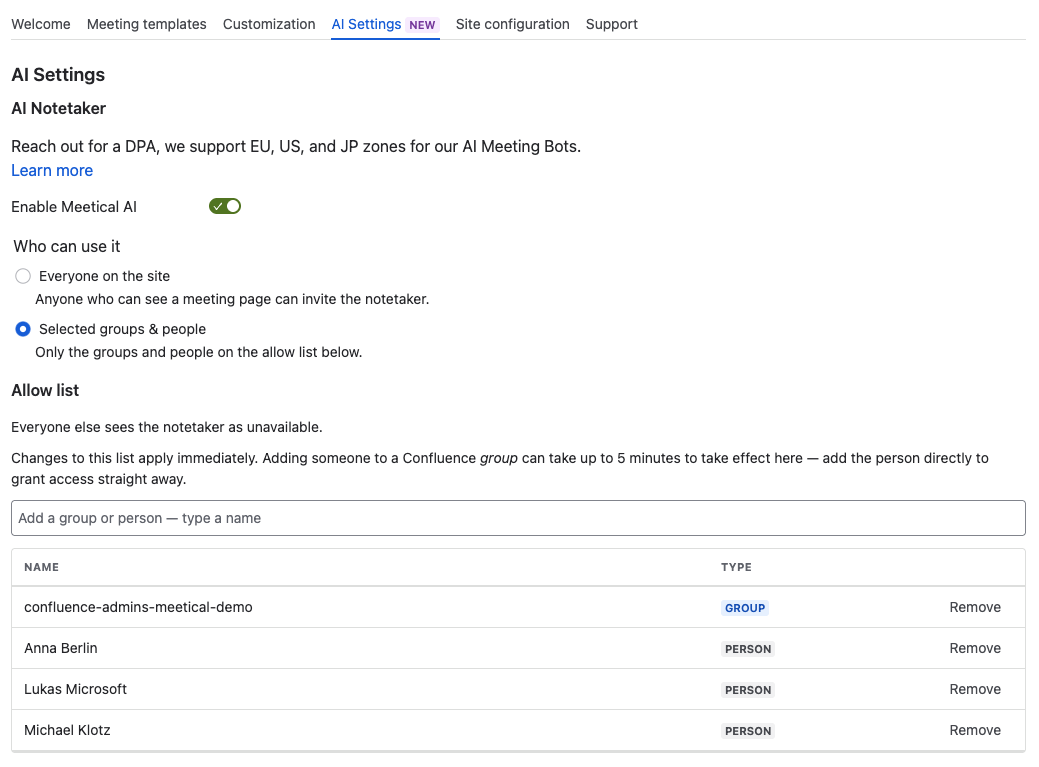
This tab controls Meetical AI, the meeting notetaker that joins calls and writes notes into the meeting page. Everything here applies to the whole site.
Enable AI
The Enable AI toggle is the site master switch. While it is off, nobody on the site can invite the notetaker, and the other controls on this tab are disabled. Switching it on or off is recorded with the account that made the change.
Before enabling AI on a larger site, contact support to get an early access quote. The notetaker announces itself in the call, but participants and external guests should know in advance.
Who can use it
-
Everyone on the site. Anyone who can see a meeting page can invite the notetaker.
-
Selected groups and people. Only members of the allow list can. Everyone else sees the notetaker as unavailable.
Allow list
Shown when "Selected groups and people" is chosen.
-
Type at least two characters to search. Confluence groups are listed before people.
-
Add a group or a person. Each entry shows its type and a Remove action.
-
There is no deny list. To exclude someone, take them out of the listed groups or remove them.
-
Group membership is cached for five minutes, so a change in a Confluence group can take up to five minutes to apply.
-
An empty allow list means nobody can use Meetical AI. The tab warns you in that case.
Default note settings
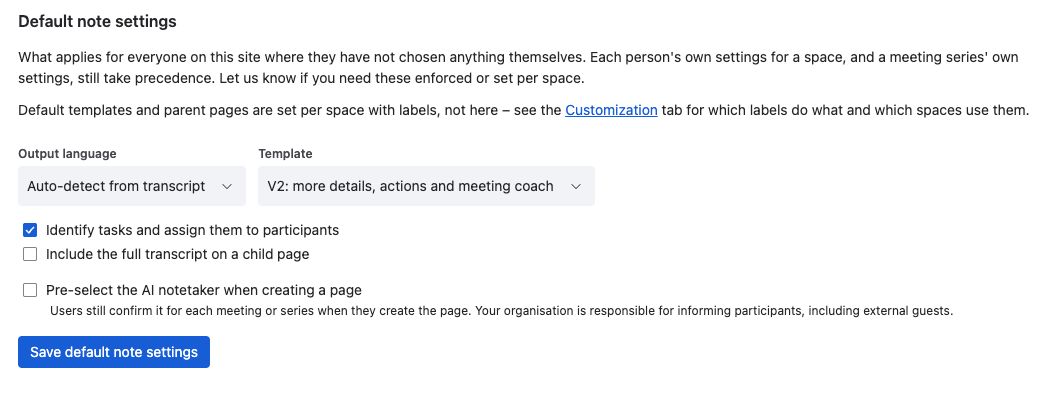
These are the site defaults for AI notes. They apply to users who have not chosen their own settings, and to meeting series without their own settings.
|
Setting |
What it does |
|---|---|
|
Output language |
Language of the generated notes, independent of the language spoken in the meeting. |
|
Template |
The note structure the AI produces, for example a general summary or a structured meeting record. |
|
Identify tasks and assign them to participants |
Extracts action items and assigns them to attendees as Confluence tasks. |
|
Include the full transcript on a child page |
Creates a published transcript sub-page under the meeting page. |
|
Pre-select the AI notetaker when creating a page |
Ticks the notetaker option by default in the create page dialog. Users can still untick it. |
Save default note settings stores them. Reset to Meetical defaults removes the site defaults after a confirmation. Parent page and template remain label driven and are not part of these defaults.
Site configuration
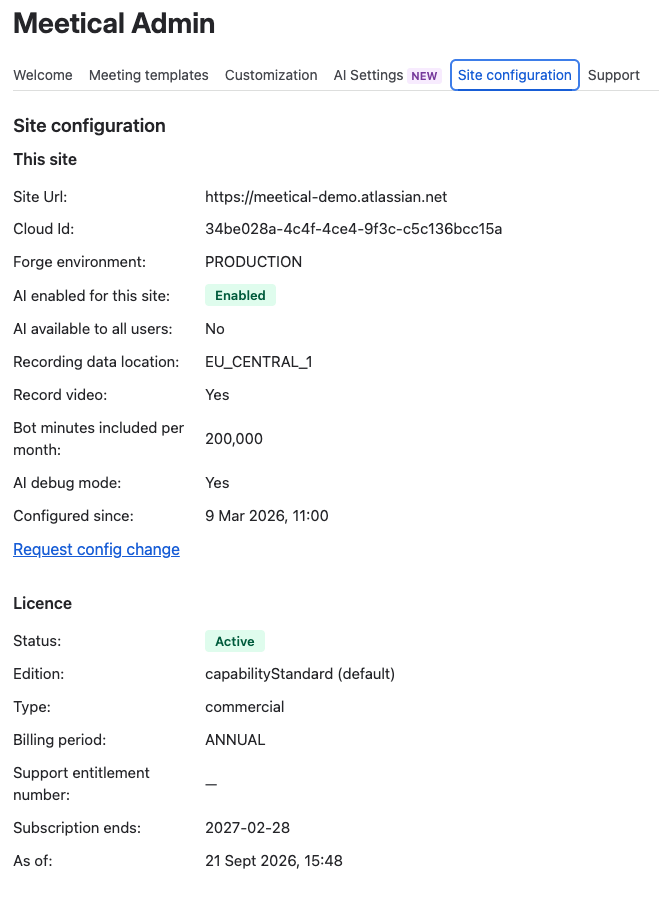
This tab is read-only. It shows how Meetical has provisioned your site and the licence Atlassian reports.
|
Value |
Meaning |
|---|---|
|
Site URL, Cloud ID, Forge environment |
Identifiers for your Confluence site. Include them in support requests. |
|
AI enabled for this site |
Mirrors the master switch on the AI settings tab. |
|
AI available to all users |
Mirrors the "Who can use it" choice. |
|
Recording data location |
Region where recordings and transcripts are processed and stored, for example EU or US. |
|
Record video |
Whether the notetaker records video or audio only. |
|
Bot minutes included per month |
The monthly AI notetaker allowance for the site. |
|
AI debug mode |
Extended logging for troubleshooting, normally off. |
|
Configured since |
When the site configuration was created. |
These values are set by Meetical. Use Request config change to ask for a different data location, video recording, or a different monthly allowance.
Licence
Status, edition and its source, licence type, billing period, support entitlement number (SEN), and the trial or subscription end date, as last reported by Atlassian. On monthly billing, the subscription end date is simply the next renewal.
Support tab and troubleshooting
Support details
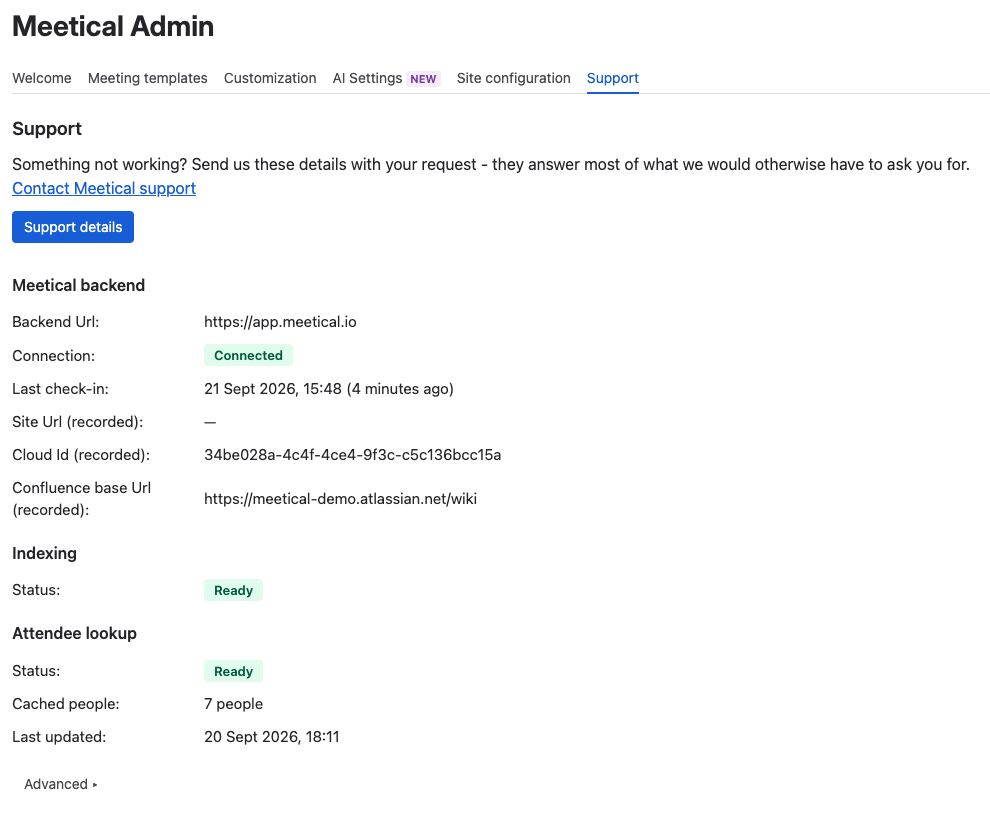
Click Support details to generate a plain-text summary of your site configuration, licence, connection state, indexing and attendee lookup. Copy it and paste it into your support request. It contains no meeting content.
Connection to the Meetical backend
The tab shows the backend URL, whether the app is connected, and when it last checked in. A warning appears when the check-in is stale or when the recorded site URL differs from the current one, which happens after a site rename.
Advanced actions
Expand Advanced for repair actions. All are safe to run except the last one.
|
Action |
Use it when |
|---|---|
|
Property check |
Indexing shows "Not indexed". Runs a search against the Confluence property index and reports the result. |
|
Send system token |
Meetical Service shows "Not connected". Re-registers the installation with the backend. |
|
Refresh attendee lookup |
Attendees are not recognised as Confluence users. Rebuilds the email cache in the background. |
|
Clear lookup |
Only on request from support. Removes all cached emails and asks for confirmation. Attendee matching stops working until the cache is rebuilt. |
Usage and credits
Meetical AI is in Early Access, pricing is currently instance per instance. Some monthly usage for AI notes and advanced automations is included with the existing STANDARD edition, more usage will be available with the ADVANCED version. Extra non-expiring credits can be bought directly with us off-marketplace. Contact us